CPM calculator
This free CPM calculator works out the cost per 1,000 impressions of an ad campaign, or solves for total cost or impressions when you know the other two. Add clicks to see CTR and cost per click, or turn a cost per click and CTR into an effective CPM.
Your result
How the CPM formula works
CPM stands for cost per mille, which is cost per thousand impressions (mille is Latin for thousand). It is the price of having an ad shown 1,000 times, whether or not anyone clicks. The three numbers are tied together, so any one follows from the other two:
CPM = cost ÷ impressions × 1,000
cost = CPM × impressions ÷ 1,000
impressions = cost ÷ CPM × 1,000
The example button uses a cost of 500, 200,000 impressions and 400 clicks. Worked by hand:
- CPM: 500 ÷ 200,000 × 1,000 = 2.50 per 1,000 impressions.
- Cost, going back: 2.50 × 200,000 ÷ 1,000 = 500.
- Impressions, going back: 500 ÷ 2.50 × 1,000 = 200,000. That is how many impressions a budget of 500 buys at a CPM of 2.50, if the platform spends all of it at that price.
- CTR: 400 ÷ 200,000 × 100 = 0.20%, which is 2 clicks per 1,000 impressions.
- Cost per click: 500 ÷ 400 = 1.25.
The calculator does the arithmetic and nothing else. It doesn't know what an impression is on your platform, which is why you should take cost and impressions from the same report and the same dates. It works in any currency, because the answer comes out in the one you put in.
Effective CPM from cost per click and CTR
Not every ad is bought by the thousand. If you pay per click, or you are a publisher paid per click, you can still put it on the CPM scale to compare it with ads bought by impressions. Each impression has a CTR chance of producing a click, and each click is worth the CPC, so 1,000 impressions are worth:
effective CPM = CPC × CTR × 1,000 (CTR as a fraction, so 0.2% is 0.002)
At a CPC of 1.25 and a CTR of 0.2%, that is 1.25 × 0.002 × 1,000 = 2.50, the same figure as the CPM above. Publishers use the same idea in the other direction, usually written eCPM: revenue ÷ impressions × 1,000. Choose Effective CPM above to try it. The result tells you what the click-priced ad comes to per 1,000 impressions, nothing more. A different audience or a different day gives a different CTR, so the figure moves with it.
CPM, CPC and CPA: what you pay for
Ad platforms such as Google Ads, YouTube and Meta (Facebook and Instagram) let you buy by different measures, and most report CPM in their dashboards whichever you pick. Knowing which one you are paying on tells you which number to watch.
| Measure | You pay per | Formula | Example |
|---|---|---|---|
| CPM | 1,000 impressions | cost ÷ impressions × 1,000 | 500 ÷ 200,000 × 1,000 = 2.50 |
| CPC | Click | cost ÷ clicks | 500 ÷ 400 = 1.25 |
| CPA | Acquisition (a purchase, sign-up or other action you define) | cost ÷ actions | 500 ÷ 20 = 25.00 |
The examples are made-up numbers to show the arithmetic, not typical prices.
They chain together. Impressions become clicks at the click-through rate, and clicks become actions at the conversion rate. If 400 clicks led to 20 purchases, the conversion rate is 5%. The same 500 was then 2.50 per 1,000 impressions, 1.25 per click and 25.00 per purchase. A low CPM alone does not show whether a campaign is profitable. Compare acquisition cost and revenue as well.
What counts as a good CPM
There isn't one number. A good CPM depends on the platform, the audience you are buying, the placement, the time of year and what other advertisers are bidding for the same people. This page doesn't list benchmark prices, because a figure from someone else's campaigns would say little about yours.
- Judge it against the rest of the chain. A CPM that looks high can still be cheap if those impressions click and buy more often. Work forward to cost per click and cost per acquisition before you call it good or bad.
- Compare like with like. The same audience, placement and dates, before and after a change. A CPM from a broad audience and one from a narrow audience aren't the same product.
- Check what the platform counts. An impression is the platform's definition, and some offer pricing on viewable impressions. Make sure cost and impressions come from the same report.
- Watch for small samples. CPM from a few thousand impressions can swing a lot from day to day. Let the campaign run before you read much into it.
The useful comparisons are your own: this month against last, one creative against another in the same placement.
Where to see what the clicks were worth in Stickybeak
CPM is a cost figure, and it comes from the place you bought the ad. Stickybeak doesn't see ad cost or impressions. It shows the other half: who arrived from the campaign and what they did.
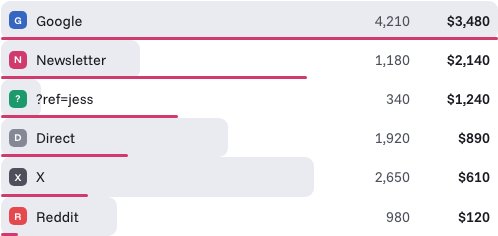
Stickybeak is live analytics for every site you own. You can filter by referrer, page, country or device, and see revenue by channel, campaign and ?ref= code. Each order keeps its trail: entry page, referrer, every UTM tag and the pages read before buying. Tag your ad links with the UTM builder, and you can set the revenue a campaign brought against what the platform says it cost. Stickybeak is in early access and doesn't have a public price yet.
Questions
How do you calculate CPM?
Divide the total cost by the number of impressions, then multiply by 1,000. If a campaign cost 500 and was shown 200,000 times, the CPM is 500 ÷ 200,000 × 1,000 = 2.50.
What does CPM stand for?
Cost per mille, meaning cost per thousand impressions. Mille is Latin for thousand, which is why the M is the Roman numeral. It is the price of having your ad shown 1,000 times, not of 1,000 clicks.
How do you calculate the cost of a campaign from CPM?
Multiply the CPM by the impressions and divide by 1,000. At a CPM of 2.50 and 200,000 impressions the cost is 2.50 × 200,000 ÷ 1,000 = 500.
How do you calculate impressions from CPM and budget?
Divide the budget by the CPM and multiply by 1,000. A budget of 500 at a CPM of 2.50 buys 500 ÷ 2.50 × 1,000 = 200,000 impressions, if the platform delivers the whole budget at that price.
What is a good CPM?
There is no single good CPM. It depends on the platform, the audience, the placement and the competition for it in the auction, and it moves through the year. A cheap CPM is not a good deal if the people reached never click or buy. Compare your own CPM for the same audience over time, and judge it with what the clicks and visits earned.
What is the difference between CPM and CPC?
CPM is the price of 1,000 impressions, whether anyone clicks or not. CPC is the price of one click. They are linked by click-through rate: effective CPM = CPC × CTR × 1,000, where CTR is a fraction (a 0.2% CTR is 0.002).
What is eCPM or effective CPM?
Effective CPM is what an ad earns or costs per 1,000 impressions, worked out from a different pricing model. A click-priced ad at 1.25 per click and a 0.2% CTR works out to 1.25 × 0.002 × 1,000 = 2.50 per 1,000 impressions. Publishers use the same idea for earnings: revenue ÷ impressions × 1,000.
Does this calculator save what I enter?
No. Everything is calculated in your browser. Nothing you type is sent anywhere or stored.