Customer lifetime value calculator
This free customer lifetime value calculator multiplies your average order value, how often a customer buys and how long they stay to give the revenue one customer is worth over their lifetime. Add a profit margin and what it cost to win them, and it shows lifetime profit, LTV:CAC and how long they take to pay back.
Your result
The customer lifetime value formula
Customer lifetime value, also written CLV, CLTV or LTV, is the total a customer is worth to you over the whole time they buy from you. The simplest version multiplies three numbers:
CLV = average order value × purchases per year × lifespan in years
That gives revenue. To get profit, multiply it by your profit margin, as a fraction, so 40% is 0.40. The example button fills in an average order of 50, four purchases a year, a three-year lifespan, a 40% margin and an acquisition cost of 60. Worked by hand:
- Value per customer per year: 50 × 4 = 200.
- Customer lifetime value (revenue): 200 × 3 = 600.
- Lifetime gross profit: 600 × 0.40 = 240.
- LTV:CAC: 240 ÷ 60 = 4.00 : 1, so the customer returns four times what they cost to win.
- Profit after acquisition cost: 240 − 60 = 180.
- Payback: 60 ÷ (200 × 0.40 = 80 a year) = 0.75 years, or 9 months.
The calculator does the arithmetic and nothing else. Every output is only as good as the three or five numbers you put in, which the sections below cover.
Revenue, profit and LTV:CAC: which CLV do you mean?
Sources use the words customer lifetime value for two different numbers, and the gap between them matters once you compare CLV with what it costs to win a customer. The calculator shows both.
| Measure | Formula | Example | Use it for |
|---|---|---|---|
| CLV (revenue) | order value × purchases per year × years | 50 × 4 × 3 = 600 | Sizing what a customer brings in |
| CLV (gross profit) | revenue CLV × margin | 600 × 0.40 = 240 | Comparing with acquisition cost |
| LTV:CAC | lifetime profit ÷ acquisition cost | 240 ÷ 60 = 4.00 | Whether a customer pays for their own acquisition |
| Payback period | acquisition cost ÷ profit per year | 60 ÷ 80 = 0.75 years | How long until you are back to zero |
The examples are made-up numbers to show the arithmetic, not typical results.
Revenue ignores what the product costs you to deliver, so a revenue CLV set against an acquisition cost makes every customer look better than they are. When you enter a margin, the calculator bases LTV:CAC and profit after acquisition on gross profit. Without one it falls back to revenue and tells you so in the result. Gross profit still leaves out overheads such as staff and tools, so a profit-based ratio above 1.00 means gross profit covers acquisition cost; overheads still need to be paid.
How to find customer lifespan from churn rate
For a subscription or any business where customers leave rather than fade, the lifespan is often easier to get from the churn rate: the share of customers you lose in a period. If you lose the same share every year, the average customer stays for the reciprocal of that share:
lifespan in years = 1 ÷ yearly churn rate (25% is 0.25, so 1 ÷ 0.25 = 4 years)
| Yearly churn rate | Average lifespan |
|---|---|
| 5% | 20 years |
| 10% | 10 years |
| 20% | 5 years |
| 25% | 4 years |
| 50% | 2 years |
Each row is 1 ÷ the churn rate. A monthly churn rate gives the lifespan in months: 5% a month is 1 ÷ 0.05 = 20 months.
A subscription example: a plan costs 30 a month, so the order value is 30 and purchases per year is 12. With 25% yearly churn the lifespan is 4 years and CLV is 30 × 12 × 4 = 1,440. Choose Use my churn rate above and enter those numbers to check it. The formula assumes churn stays the same from year to year. Real customers often leave early or stay for a long time, so treat it as an average, not a forecast.
What customer lifetime value can't tell you
The result is arithmetic on averages. It is a useful number to compare month to month, and a poor one to bet a budget on without checking the inputs.
- It is an average. A few customers who buy often can lift the average well above what a typical customer is worth. If you can, work it out for a segment, such as customers from one channel, rather than for everyone.
- The lifespan is a guess until customers have had time to leave. A business with 8 months of history can't know a 3-year lifespan. Use the time you have measured, and treat anything longer as a scenario.
- It does not discount the future. Money three years from now is worth less than the same amount today, and this formula counts them the same.
- Revenue is not profit. Without a margin, a high CLV can hide a business that loses money on each sale.
- CAC must cover the same customers. Divide the sales and marketing spend of a period by the customers won in that period, and count the same costs every time, or the ratio will drift for reasons that have nothing to do with your customers.
This page doesn't give benchmark LTV:CAC ratios or industry lifespans. They come from other companies' costs and customers, and say little about yours. Compare your own ratio against your own payback time, and this quarter against the last.
Finding your inputs, and what to do with the answer
Most of the work is getting honest numbers in. Average order value is total revenue divided by the number of orders. Purchases per year is orders divided by the number of distinct customers, over a year. Lifespan or churn comes from how long customers actually keep buying, which needs a customer list with dates, not a pageview report.
Once you have a CLV, use it for decisions it can really support:
- Set a ceiling on what you can pay to win a customer: lifetime profit is the most you could spend and still break even on that customer.
- Compare channels. A channel that brings fewer customers who stay longer can beat one that brings many who leave.
- Pick what to improve. Raising average order value, how often people buy, or how long they stay each move CLV, so change each input to see how it affects CLV, then compare the cost of making those changes separately.
Where Stickybeak helps, and where it doesn't
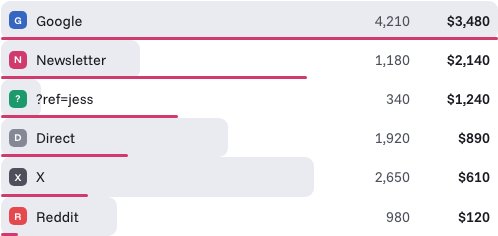
Stickybeak doesn't know your acquisition cost or your customer list, so it can't hand you a CLV. What it shows is the part that happens on your site: revenue by channel, campaign and ?ref= code, and revenue per visitor. Each order keeps its trail: entry page, referrer, every UTM tag and the pages read before buying. That helps with the channel comparison above. Its standard mode also tells new visitors from returning ones with a session count; the new vs returning visitors guide explains how that works and where it falls short. Stickybeak is in early access and doesn't have a public price yet.
On a Shopify store the setup matters: the Shopify analytics guide explains that Stickybeak records storefront visits and, with a small theme edit, checkout starts, but it can't record completed orders or revenue there. For store revenue, use Shopify's own reports.
Questions
How do you calculate customer lifetime value?
Multiply the average order value by the number of purchases a customer makes in a year, then by the number of years they stay. At an average order of 50, four purchases a year and three years, customer lifetime value is 50 × 4 × 3 = 600 in revenue.
What is the customer lifetime value formula?
CLV = average order value × purchases per year × customer lifespan in years. For profit rather than revenue, multiply the result by your profit margin. If you know your yearly churn rate but not the lifespan, lifespan = 1 ÷ churn rate.
What is the difference between CLV and LTV?
Nothing in practice. CLV (customer lifetime value) and LTV (lifetime value) are two names for the same idea, and you will also see CLTV. What differs between sources is whether the figure is revenue or profit, so check which one a number means before comparing it.
What is a good LTV:CAC ratio?
There is no single good ratio. Above 1.00 on a profit basis, a customer returns more than they cost to win. How much above you need depends on your overheads, how sure you are of your lifespan figure and how quickly you need the money back, so judge it against your own costs and payback time.
How do you calculate customer lifetime value for a subscription?
Use the monthly price as the order value, 12 as the purchases per year, and a lifespan from your churn rate. With a price of 30, 12 payments a year and 25% yearly churn, lifespan is 1 ÷ 0.25 = 4 years and CLV is 30 × 12 × 4 = 1,440 in revenue.
Should customer lifetime value use revenue or profit?
Profit is the safer choice when you compare it with acquisition cost, because revenue ignores what the product costs you to deliver. Enter a profit margin and the calculator shows lifetime gross profit and bases LTV:CAC on that. Without a margin it compares revenue, and says so.
Does this calculator save what I enter?
No. Everything is calculated in your browser. Nothing you type is sent anywhere or stored.