Average session duration: what it is and what's good
Average session duration is the total time of all sessions divided by the number of sessions. There is no single good number, because tools measure time differently and a short visit is the right result for some pages.
Add your total session time and session count to get an average session duration, and see why GA4 and older tools differ.
TL;DR
- Average session duration is the total time of all sessions divided by the number of sessions.
- There is no single good number, because tools measure time differently.
- A short visit is the right result for some pages.
Stickybeak's dashboard shows it as Session time, and you can filter by referrer, page, country or device. It is in early access.
Get early accessWhat is average session duration?
A session is one visit: a group of things a visitor does on your site in one go. Google Analytics 4 ends a session after 30 minutes of inactivity by default. Average session duration adds up how long every session lasted and divides by the number of sessions (the bounce rate calculator does that sum, and bounce rate, from your own counts). Google's reporting documentation describes the metric as "the average duration (in seconds) of users' sessions".
A worked example, with made-up numbers. Five sessions last 0, 0, 30, 90 and 300 seconds. Together that is 420 seconds, and 420 / 5 = 84 seconds, or 1 minute 24 seconds.
| Session | Pages viewed | Time (seconds) |
|---|---|---|
| A | 1 | 0 |
| B | 1 | 0 |
| C | 2 | 30 |
| D | 3 | 90 |
| E | 5 | 300 |
| Average | 420 / 5 = 84 |
Two things to notice. One long session (E) drags the average up, so the average says little about the typical visit. And if a tool leaves the two zero-second sessions out, the average becomes 420 / 3 = 140 seconds. Including or excluding zero-second sessions changes the average.
How tools measure session time differently
Time on a site is not recorded by a stopwatch. A tool only knows when it receives a signal, such as a page view or an event, so each tool makes choices about what to do when there is no second signal. Two documented examples:
| Tool | How it treats time |
|---|---|
| Google Analytics 4 | Records engagement time while the page is in focus or the app screen is in the foreground. Sessions time out after 30 minutes of inactivity by default. |
| Plausible | Counts visitors who only view one page with a duration of 0 seconds rather than excluding them. Average visit duration is the sum of all session lengths divided by the number of sessions, including those 0 second visits. |
Both come from each tool's own documentation, checked on 17 October 2026 (links at the bottom). So a site with mostly one-page visits will look very different in a tool that counts those visits as zero. Settings change this too, so check the current documentation for yours.
Average session duration in GA4
GA4's standard reports lead with average engagement time. Google's reporting documentation lists Average session duration as a metric, so if you can't see it in a report, check the metrics you can add when you customise a report or build an Exploration. Reports and menus change, so look at your own property.
The two are not the same measure. Google defines engagement time as "the amount of time someone spends with your web page in focus or app screen in the foreground". Session duration is the length of the session as a whole. Because the measures differ, don't expect an engagement time figure to match a session duration figure, from GA4 or any other tool.
For the per-session version, the name says what it is: GA4's user engagement figure is "the total amount of time (in seconds) your website or app was in the foreground of users' devices". Average engagement time per session spreads that across sessions. Average engagement time per user spreads it across users, so the two answer different questions. When a number looks too low or reads 0, the first suspects are tag problems: the tag firing twice, not at all on some pages, or a single-page app that doesn't report page changes.
What is a good average session duration?
A useful target depends on the page's job and how your tool measures time. Compare similar pages within the same tool.
| Page type | What a short average usually means | Worry? |
|---|---|---|
| Blog post or guide | The reader found the answer and left. That can be a success. | Only if you wanted them to go on to something |
| Contact or opening hours | They got the detail they came for. | Rarely |
| Pricing, product or landing page | The page didn't match what they expected, or it is slow or broken on their device. | Yes, look closely |
| Tools, documentation, long reads | People may be stuck, or they may be copying what they need and leaving. | Compare with its own history |
The comparisons that help are your own: the same page last month, the same page by traffic source, or two pages that do a similar job. A page that falls from 90 seconds to 30 after a change is a better lead than any average. Few sessions make the number jumpy, so wait for enough visits before reading a change into it. Related: bounce rate is the other half of this picture, and it has the same problem of being defined differently in every tool. Splitting sessions into new vs returning visitors often explains a duration that looks off.
How to increase average session duration
First decide whether you should. A longer session is not always a better one: a visitor who spends four minutes hunting for a phone number has had a worse visit than one who found it in four seconds. Raise the number only where the page is meant to lead somewhere. Then work through these:
- Check it's measured properly. Open your own site and see what the tool records for one visit. A tag that fires twice or never on some pages makes every figure wrong.
- Split it by source and page. One traffic source with very short sessions often means the link or ad promised something the page didn't deliver. Tagged links make this possible, see UTM parameters explained.
- Make the next step obvious. Link to the page a reader would want next, in the body text, not only in the footer.
- Open the page as a visitor would. Load it on your phone on mobile data. Is it slow? Does a banner cover the content?
- Change one thing and wait. Give it enough visits to mean something, then look again.
Looking at sessions per page and per source in Stickybeak
Stickybeak is live analytics for every site you own, and it's in early access. The dashboard shows it as Session time: the average from a session's first to its last activity, including presence pings (see site pages). It also lets you do the splitting in the steps above: click to filter by referrer, page, country or device.
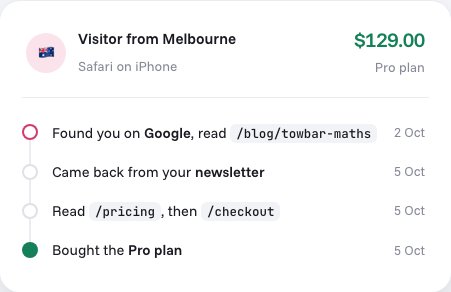
For sites that sell something, each order keeps its trail: the entry page, the referrer, every UTM tag and the pages read before buying. So instead of asking how long visitors stayed, you can ask which entry pages and sources led to a sale. That is often the question you wanted answered. See also SEO and Google Analytics for which tool answers which question.
Stickybeak doesn't have a public price yet. If you'd like to try it when there's a spot, leave your email.
Questions
What is average session duration?
The average length of a session: the time of all sessions added together, divided by the number of sessions. Google's reporting documentation describes it as the average duration, in seconds, of users' sessions.
What is a good average session duration?
A useful target depends on the page's job and how your tool measures time. Compare similar pages within the same tool, and judge each page by its job: a page that answers one question can have a short average and still do its work.
Where is average session duration in GA4?
Google's reporting documentation lists Average session duration as a metric, but the standard reports lead with average engagement time. If you don't see it in a report, check the metrics you can add when you customise a report or build an Exploration.
What is the difference between average engagement time and average session duration?
Google defines engagement time as the time someone spends with your page in focus or your app screen in the foreground. Session duration is the length of the session as a whole.
Why is my average session duration so low or zero?
Many tools measure time between actions, so a visit with one page and no event has little to measure. Plausible, for one, counts single-page visitors as 0 seconds. A site where most visits read one page will show a low average. Also check that your tag is installed once and fires on every page.
How do I increase average session duration?
Make the next step obvious, link related pages to each other, keep pages fast on a phone, and make sure the page matches what the link or ad promised. Treat the number as a clue, not a goal: a longer session is not always a better one.
Does average session duration affect SEO?
This guide doesn't make that claim. Session duration is a measurement in your own analytics, and we can't show that it feeds any search ranking. Use it to find pages that aren't doing their job.
Sources, checked 17 October 2026: Google Analytics Help, Session (30-minute default timeout) and User engagement (engagement time). Google Analytics Data API, API dimensions and metrics (average session duration, user engagement). Plausible Analytics documentation, Metrics definitions (visit duration).